Thanks love this!!!
2 Likes
Awesome BB But Thanks go to @MasterOfMartialArts
His ContenTTT
1 Like
Thanks brother
Yeah Baby !
1 Like

2 Likes

2 Likes
killa contributor moma
3 Likes
Low kicks article just went up on Substack.
1 Like
Legs. When you’re standing in front of somebody having a conversation or in line at your local supermarket, you see a pair of legs. Sometimes this person annoys you, and you’d like to take one of your own legs, and use it to smash one of theirs. Here is what a set of legs look like, in case you need a refresher:

1 Like
Locomotive in nature, human legs are also referred to as lower extremities, as they are half of our entire bodies. These limbs allow us to stand, walk, run, swim, jump, skip, and even hang upside down from trees. Given that these lower limbs are pivotal for the support of our upper body and upright movement, damage to legs can make moving around quite troubling. Since the point of combat is to damage your opponent, it’s only natural that human legs would be a huge target of attack for fighters. That’s where low kicks come in. Today, we will be talking specifically about the history of Dutch low kicks.
It’s incredibly difficult to pin down exactly when the first low kick was introduced, given that the first illustrations depicting martial arts are estimated to go as far back as 3000 BC. However, the first known mention of a low kick that I can find is in the epic story of The Odyssey – written by Homer in the 7th century BC. It is estimated to be authored between 700-750 BC. Page 228 of the English version reads:
“With that he passed by, and as he did so the fool landed a kick on Odysseus’ hip”[12]
We obviously don’t know the exact technique Homer is talking about here, and we also don’t know if was just a matter of kicking Odysseus’ hip like you would if you wanted to get your little brother off of you. Whether or not this kick has anything to do with martial arts, this time in Greek history happens to be right around the time of the development of a combat system known as Pankration. This system is thought to have been founded around 700 BC, and it was introduced into the Greek Olympic Games in 648 BC[20]. This discipline had the hallmarks of modern arts we see today – punches, kicks, grappling and wrestling techniques. It was also used by Greek soldiers when they didn’t have weapons and had to engage in hand to hand combat[20]. These techniques have been described and depicted in art such as literature, illustrations, and statues. One such example proves relevance to this article – an image of a man shown throwing a “front low kick”, estimated to be from the Archaic Period, which is between 800 BC and 480 BC:
1 Like

This was over 2,000 years ago. The low kick you see being depicted in this statue isn’t one we are used to seeing today, as it aims to strike with the heel of the foot into the area of the quadricep, right below the hip. The purpose of a low kick is to do damage, disrupt rhythm, and limit mobility. What kind of low kicks do we (primarily) see now? Well, that’s what we’re here to discuss. In order to understand how this technique ended up in dojos and on televisions all over the world, we need to explore some of the history surrounding it.
Let’s fast forward to 1960s Japan. This was 60 short years ago and the country was a martial arts hub. Karate, Judo, Boxing, Professional Wrestling, and Sumo were all part of Japanese culture at this time, with room to grow. During the late 1960s, there was a Kyokushin Karate black belt named Kenji Kurosaki, who started developing his own style of Kyokushin, combining the techniques of traditional martial arts with the tactics and philosophies of Muay Thai. Here’s a quote from the previous article I wrote, entitled: “Joe Lewis: A Fighter Evolved”:
“This was happening at a time in Brazil where some Martial Artists like Marco Ruas decided crosstraining was a good idea – parallel thinking by some of the great minds of Martial Arts.”
In this quote I was referring to a phenomenon occurring throughout the 1960s and 1970s where martial artists were branching out and expanding their ideas on styles, techniques, practices, and philosophies. This shift was challenging the conventional ways of thinking that dominated martial arts for centuries. A lot of these changes were taking place because of individual martial artists and their ideas of what “combat” should look like – shaped by their upbringing, geographic culture, fellow martial artists, their own individuality, and other factors. Kenji Kurosaki was a black belt in Kyokushin Karate. Now reading the words “Kyokushin Karate” may make you visualize two guys in a karate gi breaking boards, making various hand gestures, and yelling “Osu!”. While that may be part of the discipline, Kyokushin actually differs from most other Japanese Karate forms, in that it puts a greater focus on more realistic fighting. It can be characterized by its aggression, hard sparring, and the importance of damaging an opponent. Most Karate styles consisted of light contact, but Kyokushin allowed full contact strikes in sparring. That simply wasn’t enough for Kurosaki, and he began to pull away from his sensei (Masutatsu Oyama, founder of Kyokushin Karate) in the late 1960s. So what made Kenji Kurosaki want to develop his own subsect of Kyokushin, instead of continuing to practice what he knew?
1 Like
Into Oblivion
In 1964, Kenji Kurosaki and two other Karatekas were invited to take part in a fighting challenge against three Thai fighters[6]. This challenge would involve these three martial artists flying to Thailand, and competing against three Nak Muays – all under Thai rules. The other two Karate fighters were Tadashi Nakamura and Akio Fujihira[7]. These two won their fights, respectively, with Kenji being the only loser in the bunch, falling to Rawee Dechachai by an elbow strike[7]. Kenji would see very little success in the fight, only scoring anything significant when Rawee got close enough, and he was able to throw him (which was legal under the ruleset). Rawee’s pressure proved to be too much for Kenji to handle. He landed a lot of low kicks, elbows and middle kicks, until he eventually landed the elbow that finished the job[3]. Disappointed with the loss but determined to learn from it, Kenji Kurosaki was inspired by his own experience in the ring, and vowed to create a style that held up better under pressure, and in different environments. Despite this personal goal, Kurosaki traveled to Hawaii and the Netherlands to help his sensei spread Kyokushin Karate across the world[6]. But, Kurosaki’s loyalty to Masutatsu Oyama would eventually come to an end. Although Kyokushin was closer to real combat than most other Japanese forms, Masutatsu Oyama insisted that practice still be performed bare fist, which meant no punches directly to the head were allowed[6]. Contradictory to Oyama’s own philosophy about Kyokushin being closer to street fighting, Kurosaki saw Oyama’s rule for what it was. Kurosaki subsequently left Oyama dojo in 1969 and started his own academy, eventually named “Mejiro Gym” (Mejiro being the district of Japan it was located in) in the same year[6]. It was here that Kurosaki developed the style that would come to be known as “Japanese Kickboxing”. He trained Toshio Fujiwara (who became the first Japanese “Kickboxer”) and Jan Plas (an important Dutchmen we will talk about soon), and created a lineage of insurmountable significance.
Japanese Kickboxing
Now, what exactly is Japanese Kickboxing, and how did it differ from Kyokushin or Muay Thai? Well, it’s easy to conceptualize. The easiest way to think about it is to describe it as Kyokushin Karate with elements of boxing and Muay Thai, with a greater emphasis on damage and practical fighting application. Imagine a fighter with the technique variety and footwork of a karateka, the hand combinations of a boxer, and the speed, power and fluidity of a Muay thai fighter. Now this is how Japanese kickboxing got started and is the general framework, but it goes without saying that there are different ways to blend arts together. To illustrate this, here’s Toshio Fujiwara, prodigy of Kenji Kurosaki and the Mejiro style:

Fujiwara’s background in the Chinese martial art Taikiken gave him a unique base, which would be proven by the way he moved inside the ring. Fujiwara started training in 1969 under Kenji Kurosaki and learned the Mejiro style, making his kickboxing debut the same year[22]. Toshio would go on to win the AJKA (All Japan Kickboxing Association) championship in 1971, and become the first non-Thai fighter to win a Rajadamnern Stadium title in 1978[22]. Unlike most Karate fighters, he didn’t bounce on the balls of his feet. Rather, he moved more like an elite boxer, using a lot of lateral footwork. He used this movement to dart in and attack, then retreat quickly either by switching angles or moving straight back, to avoid counters. His left high kick was as fast as any I’ve seen, and he sometimes preceded it with a low kick using the same leg. Fujiwara had a multitide of weapons with his hands as well, among them his right cross and leaping left (lead) hook. He often lept into his strikes and upon landing, would be in the opposite stance, firing more strikes before his opponent could respond or recover from what he just threw. Although he wasn’t known for combinations in the conventional sense, he mostly threw one strike at a time, targeting different areas of the body and never letting his opponent rest or reset.
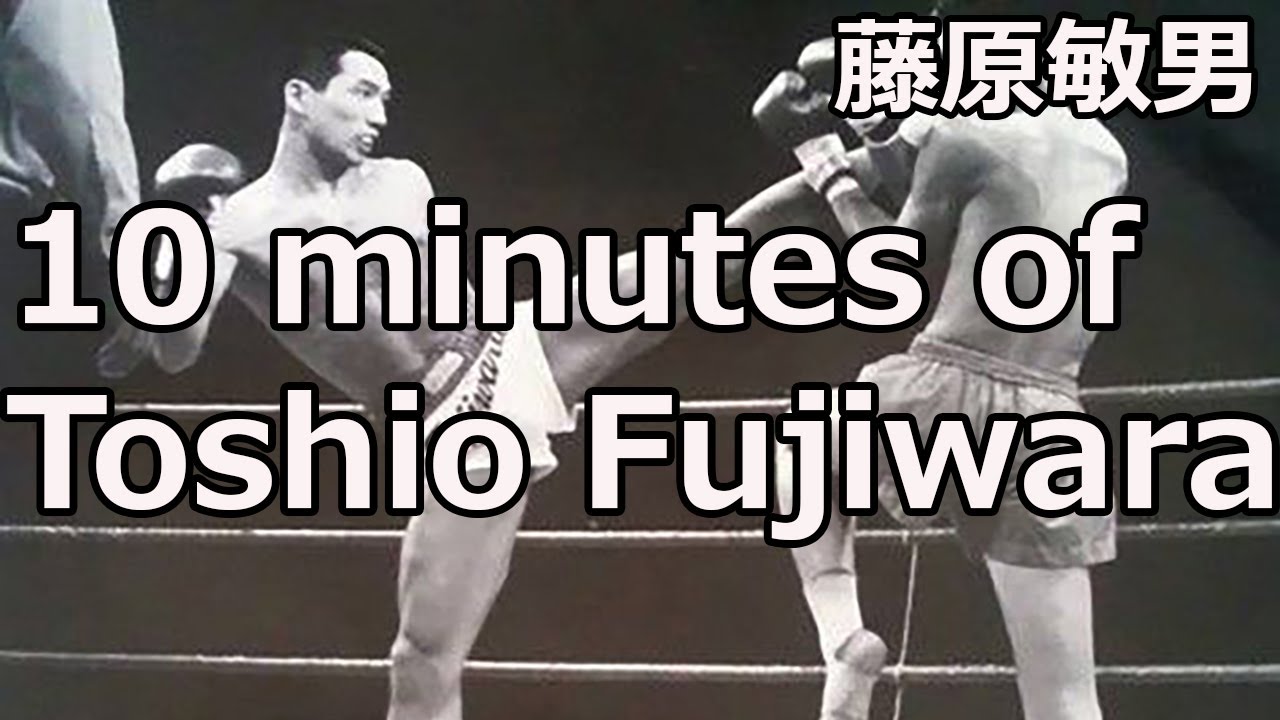
Although Fujiwara had an incredibly unique style that will likely never be replicated, why are we talking about Japanese kickboxing? All styles of combat started somewhere and were taught to martial artists, who then passed it down through generations – transcending borders, language, and culture. Every student has a teacher, and every teacher has students. Simply put, every martial art has a lineage. Toshio Fujiwara may be a rare specimen when it comes to Japanese kickboxing, but his game still aligned with its principles. Those employing this particular style generally combine traditional martial arts techniques with high volume and speed, with an emphasis on footwork and defensive responsibility. These fighters blend punches and kicks together really well, and display a wide array of weapons, bringing in Karate techniques such as side kicks and spinning attacks. In the above video you’ll see Toshio throwing teeps and even using the Thai plum to slam knees into his opponent’s face, which both came from pure Muay Thai fighters (Nak Muays). Since a lot of Japanese kickboxers have traditional arts expertise, we also see a lot of boxing influence in their footwork and defensive movements. There is a long history of boxing in Japan, and in the 1960s and 1970s, Toshio looked up to guys like Muhammed Ali and Floyd Patterson. It’s easy to see why this style has become such an effective striking art, carving a path for fighters like Masato Kobayashi and Masaaki Satake.
3 Likes
DUDE!
2 Likes
Yeah He Bad !
1 Like
nation wide?
1 Like
Yo this thread is fucking awesome
2 Likes
Thats why we TTT The ShiT
2 Likes

1 Like
Thanks brother
2 Likes