My first official “how to” video, it’s only 3 minutes, feedback is welcome and necessary if anyone has time.
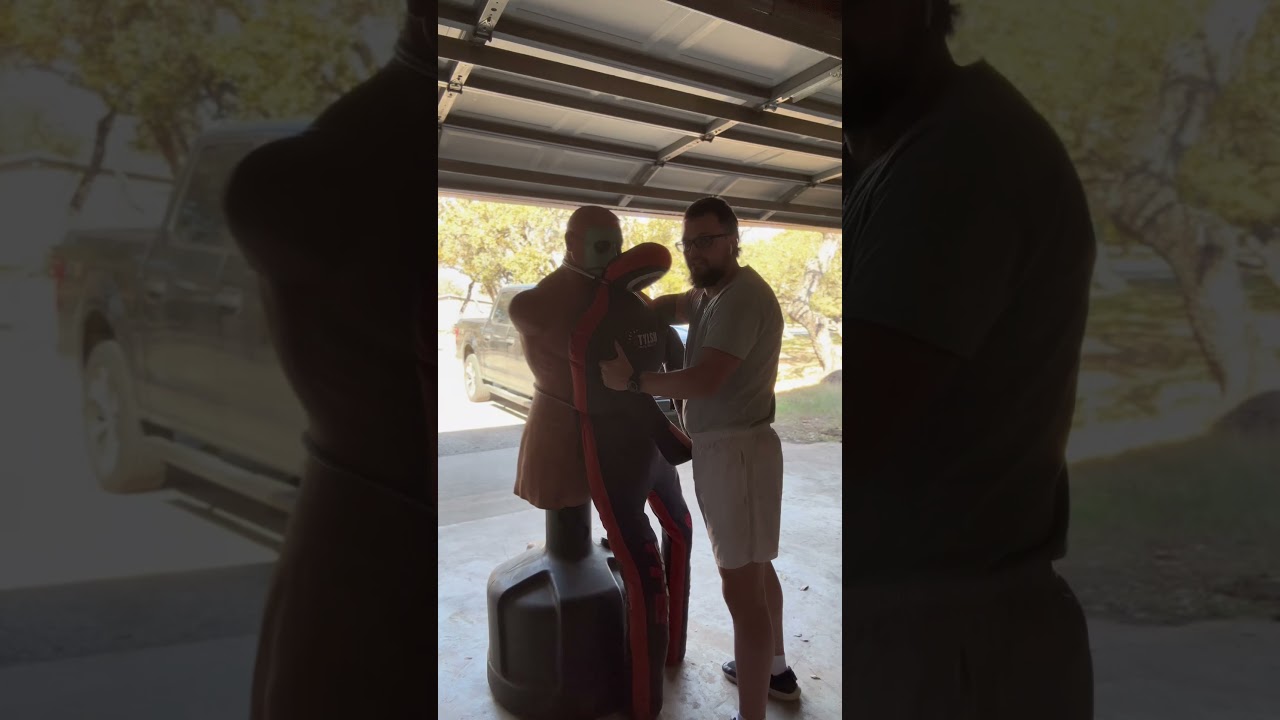
My first official “how to” video, it’s only 3 minutes, feedback is welcome and necessary if anyone has time.
It comes up as a short because of the 9:16 aspect ratio I used for TikTok.
Tactic 1
[excuse the quality, some of these are screenshots from the fight itself, not still images]
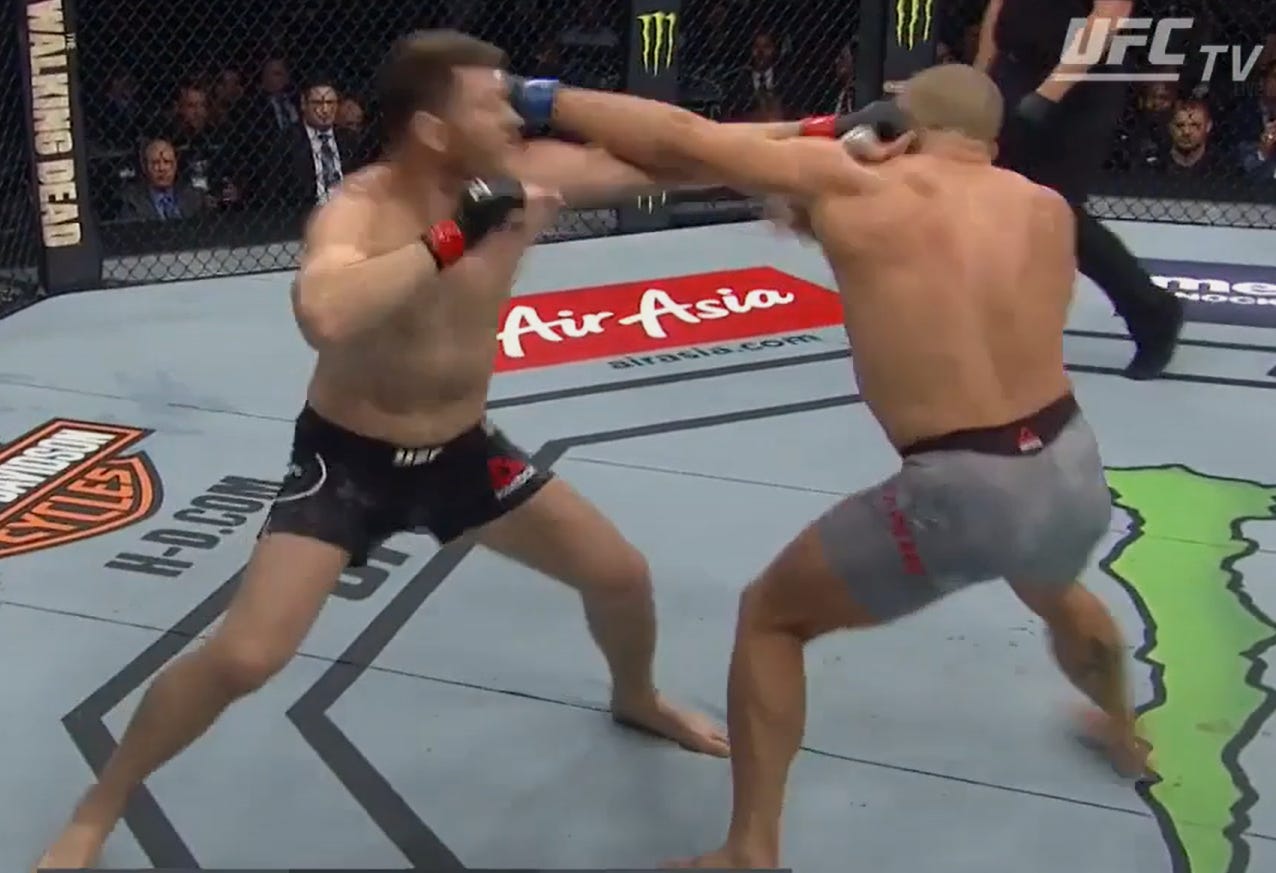
Bisping had one of the best jabs in MMA for a long time. He has different jabs, but the one he likes to use the most is his “pawing” jab. Everything he throws comes from that punch, and he can use it to either keep his distance or set up combinations. His entire game is based around his jab and it is pivotal to his being successful in the cage. Obviously St. Pierre is going to use this fact to his advantage - his goal was to shut this jab down completely. He would either throw with Bisping (shown above), or counter it immediately following a slip or parry. In both cases, this served multiple purposes. The first is that it made Bisping mindful of the fact that he wasn’t going to be able to use his jab the way he is used to, forcing him to find offense in other ways. The second thing, and this is possibly the most critical, is that neutralizing Bisping’s jab prevents him from getting into a rhythm. He likes to pressure guys and throw a lot of volume. The more he establishes his range and lands strikes, the more comfortable he gets, the more pressure he applies, the more fluid he becomes. This cycle continues as the fight goes on, his output increasing with each subsequent round. The longer the fight went on, the more it benefitted Bisping, especially being that St. Pierre was coming up a weight class and hadn’t fought in 4 years, and Georges needed to be smart if he was concerned at all about his own conditioning after putting a bunch of weight on.
If GSP waited for Bisping to throw first and only threw after him, it would allow Bisping to get comfortable throwing combinations and give him time to exit before Georges could fire back, which he often does. It would also allow Bisping to get his rhythm and timing on St. Pierre. Not only did GSP throw with Bisping’s jab, anytime Bisping threw at all, Georges was throwing too. He would even sometimes feint when Bisping feinted, leading to these weird mirror moments.
This jab elimination forced Bisping to look for other ways to get his offense going, and put him into a countering mindset, which is something he can do, but isn’t his bread and butter. Those were the best openings for him - which GSP mostly avoided by backstepping or pivoting away. Here GSP throws a superman jab-rear low kick and Bisping tries to counter with a right hook, but St. Pierre is so well balanced and is able to move his top half back just enough to make him miss.
Tactic 2
[GSP did this to everyone, but it’s especially important in this fight]
GSP operates off a jab when he’s standing just like Bisping. The difference is that Georges has more weapons, and more ways to control distance. Being that he has a Kyokushin background, he doesn’t need you to let him jab you all night. But he’s very good at that. In the first round against Bisping, he had trouble finding the range with his own jab. Although their reach was nearly equal, Bisping’s height was making it hard for St. Pierre to find the target. No jab? He just kicks Bisping in the leg.
Georges opened the fight with a teep. It doesn’t seem like much when you’re watching but to me, it looked like he was using that teep to set up the kicks he would be throwing all night. The first time Bisping engaged with a jab, as we analyzed earlier, GSP met him with his own jab. He did this several times in the first round. Once he was done jabbing with Bisping or just slipping it, he started countering it.
In a high level championship fight, the best way to set something up is to dress it up. Give it a disguise. The best way to do that is by presenting a threat. Once the threat has been established, it can be used as a trick. Let’s say I’m your roommate and the last two times you’ve come home, I left a turd right behind the front door so you step in shit right when you walk in. Let’s say today you come through the back door instead. Well, surprise, more shit. Even though you tried to avoid stepping in shit, you still stepped in it anyways, but why? Because I knew you were going to come through the back door, I used that as a trick to get you again in another location. If this pattern continued in different locations, you would probably come home and freeze up, unsure of what to do and how to adapt to said pattern.
What I just described is what Georges St. Pierre does when he’s striking. He has so many tools in his toolbox, and utilizes every single one of them, INTELLIGENTLY. He will respond differently to the same technique, change his stance, offer an unorthodox technique in response to a new opening, or change his approach and tactics altogether. About midway through the first round, here is GSP looking for a lead left hook, but missing. I don’t think he is trying to land this, but he wants to see how Bisping reacts to it. This will be important later.
Here is the last 20 seconds of the first round. St. Pierre lands a long range superman jab and follows it up.
Superman jab. Spinning wheel kick. Jab. Double leg. Clinch. Rear elbow. All in a span of less than 10 seconds. See how GSP is starting to look completely unpredictable?
He opens the round with a side kick followed by a teep. He throws the side kick with the rear leg, which is uncommonly seen in MMA. He precedes it by slightly rotating his hips and bringing his rear leg up like he’s throwing a low kick, but instead chambers his leg and snaps it outward. Here is St. Pierre throwing a jab to the body, notice the hips drop or “level change”.
Here’s another level change.
Here GSP throws that same rear leg side kick again but comes up short. What follows is a faked jab and takedown. The word “fake” is important because Georges never meant to land it. If you slow the footage down and look at the punch, watch his lead arm and elbow. He flares it out and starts the punch almost like a hook. As he extends his arm he straightens it out, finishing the full extension a few inches from Bisping’s chest. By the time he pulls his arm back, his head is already below Bisping’s waist, arms grasping for his legs.
“Level change”.
Remember the missed left hook from the first round? Here’s where we talk about what GSP did to confuse and trick Bisping on what he was gonna be throwing. Let’s see Georges put the finishing touches on a fantastic performance.
Let’s look at this picture.
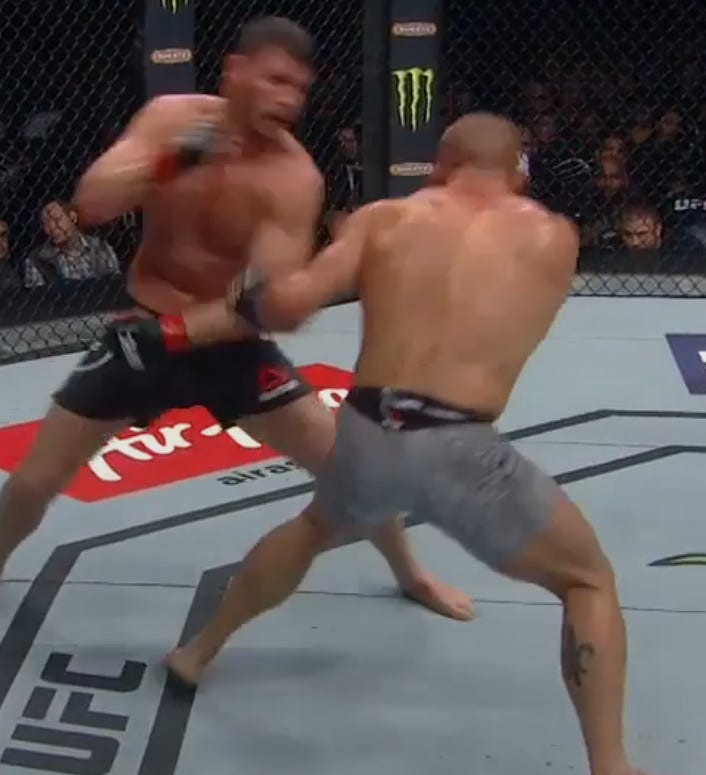
What is St. Pierre doing? He’s dropping his level. In response to Bisping’s overhand right, GSP is ducking under. Since Georges lowered his head, Bisping follows up the right with a left hook that is aimed at a lower target. We know that when GSP lowers his level, he has multiple weapons:
-left hook
-takedown
-body jab
In addition to multiple weapons coming from the same position, Georges had been countering Bisping’s jab with his own overhand right all night. The goal of using this overhand right was to get Bisping thinking about his own left side. This time, GSP threw his left instead of right, which isn’t something he had thrown much at all, and hadn’t threatened with it in the pocket a single time. Being that Bisping was expecting the right hand and was also blind in his right eye, he never saw the punch coming.
Georges St. Pierre finished Michael Bisping in the third round via rear-naked choke. His first stoppage victory since the second Penn fight, and the best he looked in years. He hadn’t fought in four years and was 36 when the fight took place. Greatness can’t be quantified.
Long live The Ultimate Fighter.
El Guapo. If there is one name that all die hard fans of MMA and NHB recognize, it’s Bas Rutten. In the 1990s, Bas was the ultimate paragon. No Holds Barred was a brutal form of combat, and Bas was known as a particularly aggressive Dutch Kickboxing stylist. Yet, in a cult sport full of meathead tough guys and performance-enhancing substances, Bas brought honor, discipline, sincerity, and creativity to the ring. We all know that the supreme proving ground for fighters was the Ultimate Fighting Championship, even in the 90s. Although all but three of his 33 fights took place in Pancrase, he ultimately secured UFC Heavyweight gold when he beat Kevin Randleman at UFC 20. Before that, Bas already had wins over the likes of Guy Mezger, Frank Shamrock, Vernon White, Maurice Smith, Jason DeLucia, and Masakatsu Funaki. Bas did have two early losses to Ken Shamrock, but was unable to avenge those losses, as a third fight never materialized. Bas’ achievements in the world of Martial Arts are nothing to sneeze at: 5th Dan black belt in Kyokushin Karate, 2nd Dan black belt in Taekwondo, 1st Dan black belt in Judo, three time King Of Pancrase, and one time UFC Heavyweight Champion. Not too shabby for a guy who couldn’t train consistently until he was an adult because of his parent’s disapproval, and had zero ground training when he debuted in Pancrase. Not only did he exclusively have kickboxing experience when he transitioned to No Holds Barred, but he lived in Holland, which was known for its kickboxing academies, not its wrestling or jiu jitsu schools. He is well known for his punishing knees, and crushing low kicks. His liver attacks were so accurate and destructive that he may as well have patented any strike to that area, insomuch as Bas’ liver shots were as dangerous and effective as any fighter we have ever seen, past or present. Unlike “The Uncrowned King” works, I will not be covering all of Bas’s wins. I have selected a few of Bas’s individual fights to cover, in order to demonstrate the fighting prowess and tactical genius of El Guapo.
Before we talk about any of Bas’s fights, it’s important to note that his first 31 fights were fought under a ruleset unique to Pancrase. This organization pre-dates the UFC and its early format was derived heavily from professional wrestling, since its founders Masakatsu Funaki and Minoru Suzuki were catch wrestling practitioners. I’m not going to list all of the original rules, but I will talk about a few notable ones:
No elbows
No closed fist strikes to the head
Five “rope escapes” are given to each fighter in each fight. If one person grabs the ropes, the fight is reset on the feet in the center of the ring.
Round times vary based on the format (standard bout, title bout, tournament bout) but as a whole, fights were one round.
Early Pancrase rules consisted of one 15 minute round for non-title bouts and one 30 minute round for title bouts. Tournament fights would have been one 10 minute round plus one overtime. However, Bas has gone on record saying his early fights were all 30 minute rounds, which is what Tapology has documented. With that being said, there are a couple of important things to mention regarding the rules. In PRIDE, if their fighters got entangled in the ropes, the fight would be reset in the middle of the ring, with both fighters being placed in the same position. In Pancrase, if there is a rope escape or the action is taking place too close to the ropes, the fight is reset in the center of the ring. However, instead of them being put in the same position (if on the ground), the two fighters are stood up as they are at the beginning of the round. This rule benefits strikers, and it certainly aided Bas in some of his fights, although as you will see, it also hurt him at times. He admittedly had very little ground training early in his career, and was repeatedly taken down and controlled by wrestlers. But as far as striking is concerned, Bas was on another level. The other thing worth mentioning is while there were strikes allowed on the ground, they were discouraged by fans, and went relatively unused in Pancrase’s early days. Bas himself stated that he did not strike on the ground due to the perception at the time, but if his opponent did so, he then reciprocated.
Guys I set up an Etsy shop! The design is created in a collaboration between me and a local artist. The goal is to create clothing & gear with the spirit of martial arts. This is just the first design, which is my logo and the logo banner. But I will be working on creating more designs. I do own two shirts and they are comfortable, true to size. Made and shipped from the US.
He would have been unable to avenge them anyway.
Hey hey hey watch your mouth buddy
Bas Rutten is to me, what Ken Shamrock is to you
That’s fine Bas is a stud.
I’ve never said anything negative about the guy.
But Ken was a bad matchup for him, and characterizing those fights as being “early on”, as if the outcome would have been different later, isn’t realistic IMO
Bas fought like 10 times in '95 with wins over guys like Smith, Fuke, Suzuki, Mezger, and Frank – Ken being his only loss that year.
Fun fact:
Ken is the only guy Bas fought and never beat.
I think it would have been different later on. By 1997 Bas was evolving at an incredibly rapid pace and had already submitted Suzuki, Mezger, Maurice and Fuke. Not that these guys are Ken Shamrock cause they aren’t, but he was showing a different level then what he showed in ‘93-‘95.
I also had him winning both fights against Frank and thought that those fights were likely how a post-1995 matchup between Ken and Bas would have gone. If Ken did beat him a third time, it would be due to the wrestling chops and Bas simply not being able to stop the takedown. He would be able to get up and create scrambles, make the fight longer, which benefits him.
I’m not saying Ken wouldn’t beat him, but Bas has a much better chance a third time than he did the first two. He’s a completely different fighter on the ground. Ken would still take him down but I think Bas was skilled enough to defend the submissions.
That would have made the third fight much more interesting than the first two. Bas was also at a disadvantage given he didn’t really have training partners with the knowledge of training of ground positioning and submissions. It’s very impressive what he was able to teach himself. A third fight at the very least is way more competitive.
Again I think Ken was just a bad matchup for Bas.
Ken was just too much physically.
Even in their brief striking exchanges where Bas should have had the advantage, he didn’t.
Ken was a freak back then.
I think Bas and Frank matched up better.
Nobody in Pancrase could legit beat Ken at that time. He was their most dominant fighter by far. The only way they could get him to lose was to have him put guys over.
Ken was the most dominant Pancrase fighter of that era, and then Bas was the most dominant Pancrase fighter after Ken.
Must have pissed the Japanese fighters off lol!
.
He submitted those guys in '95, same year Ken beat him the second time.
That’s the point I was making.
Bas was beating everyone but Ken.
Bas was more active with bigger wins in '95 than he was in '97.
Funaki in late '96 was a big one for sure!
@onepunchJD @MasterOfMartialArts
Bas asked to be Ken’s first fight back in Pride after Ken’s return from pro wrestling in 2000. Bas had said this fight was considered by Pride brass, but ultimately Ken really wasn’t that interested after already having two submission victories over Bas already in Pancrase. I do think this would have been a real challenge for Ken had it come to fruition considering Ken’s long layoff and where Bas was skill-wise at that point. Early/mid 90’s Ken was just too much for Bas at the time. Ken’s strength and ground ability were at such a high level. His ability to control fighters and transition into a kneebar or heel hook were off the charts. Bas has also talked about a stand-up rules only, no takedowns fight that was discussed with Wanderlei Silva in Pride in the early 2000’s that never came to pass. That would have been a lot of fun to see.
I absolutely love Bas Rutten and even had the privilege of meeting him. Such a high level fighter in his time and a class guy. What I’m about to say is in no way to be taken as disrespect, but Bas did not beat Randleman that night for the title - in my opinion. I’m not sure what the consensus is here among most OG’ers, but Randleman is the man that controlled and won that fight that night. It was interesting hearing Obake discuss this on @MMAHistoryPodcast as one of the judges that night. He gave Randleman the nod as well. I love Bas and I’m glad he was champ, but I don’t feel he beat Randleman that night.

