
3 Likes
Thanks brother!
You looking at the substack? Much better format and less clunky.
Can’t do articles without embeds anymore lol. There has to be a visual aspect.
1 Like
Thanks brother!
I looked at it through the regular site link here not the substack. Is there more content there or just better interface?
1 Like
Here is the substack. It’s the same content with a better interface. It’s also just easier for me to use in general. I will keep using the site to mirror content but eventually it will be used to sell clothing and other products.
3 Likes
The substack is out of order and I did it that way on purpose to highlight the first articles I wrote. Plus I can schedule them and during the summer I didn’t get to write as much.
I’ll continue posting stuff in here. Thanks to everyone in this thread for the support.
1 Like

From the title I think know where you’re going, and I love it.
1 Like
I’m in the middle of doing a breakdown video and after I’m gonna write a full article to accompany it. Believe it or not it’s the first full official breakdown I’ve done on an individual fight.
1 Like
ITS YOUR THREAD !!!
1 Like

2 Likes
What?
It’s time to talk about Joe Lewis and the 1st USA Pro Team Karate Championships. Long Beach, California, January 17, 1970. Greg Baines’ name is spelled incorrectly on the original poster (it’s spelled Greg ‘Banies’).

3 Likes
TeaTeeTtt
As a Martial Artist or Fighter, how do you test the effectiveness of the techniques you learn in training?
Damage.
At least, that’s according to one of the greatest Martial Artists to ever live, Joe Lewis. One night in January of 1970, Joe Lewis’s telephone rang. Hollywood stuntman and student of Lewis, Lee Faulkner was on the other line1.
Faulkner: I want you to fight in my upcoming event, the United States Karate Championships.
Lewis: I’m retired from point fighting, but I will fight if I can wear boxing gloves, and knockouts are allowed.
Faulkner: If I get you a match, will you do it?
Lewis: Fine.
Faulkner: Who do you want to fight?
Lewis: I want a Shotokan fighter, I don’t like their arrogance.
Faulkner: Consider it done.
Although Lewis didn’t end up fighting a Japanese Shotokan specialist, he did fight, and knockouts were allowed. The contest took place on January 17, 1970 and was called “Pro Team Karate Championships” – the first full contact fight to have a USKA (United States Karate Association) belt on the line. In this context, full contact means punches, kicks, elbows and sweeps are allowed, with only a decision or knockout being ways to end the fight. The event took place in Long Beach, California at the Long Beach Sports Arena. Lewis ended up in the ring with a man named Greg Baines, a Kenpo stylist who was one of the best in the world at that time. Lewis wore boxing gloves and sneakers, while Baines wore gloves but chose to go bare foot. Joe Lewis adopted a modified Karate stance: bladed with hands down, yet upright and long. Both men showed a great ability to neutralize each other’s kicks so the fight became a boxing match between two karate stylists. They also displayed stance switching, some hip feints, and great defensive movements. After a minute, Lewis established himself as the better of the two. He landed his right hook at will, seemingly baffling the (mostly) linear attacks of Greg Baines. These angles would prove to be trouble for Baines, as Lewis got inside the pocket, and landed yet another huge right hook. Lewis stepped back for a moment while Baines was dazed against the ropes, then went back on the attack, landing a wondrously fluid overhand right. The fight was over in just three minutes.
1 Like
A Sense Of Purpose
When I watched the footage trying to determine where Lewis’s advantages were, it became painstakingly clear: Lewis was the better boxer. He displayed superior hand speed, punching technique, inside fighting, and ring IQ. Additionally, Baines was lacking in the areas where Lewis excelled, widening the gap between them. Had this been a karate match it likely would have been very competitive and yet, Lewis’s commitment to martial arts and willingness to cross train in other arts gave him a massive edge. In that sense, Lewis was ahead of his peers in American Karate – he trained under Bruce Lee and studied several boxers. Along with Bruce’s help, Joe Lewis closely watched Willie Pep for his footwork, Jack Dempsey for his explosiveness, Joe Louis for his inside fighting, and Ali for his tactics and mobility. He actually trained with Sugar Ray Robinson and another boxer named Joey Orbillo – a less prominent but highly respected professional boxer active during the 1960s. Lewis told James Lew in a 1981 interview that the double lead hook, which he landed frequently throughout this fight – was shown to him by Bruce Lee himself. Because of his training with Lee and Lewis’s own personal philosophy, he didn’t believe in limiting himself to one style or specialty. Aside from boxing, Lewis trained in Kenpo, Judo, and even Folkstyle Wrestling. At the time this contest took place in 1970, zero other promoters were organizing full-contact fights in the United States, and there wasn’t much crosstraining going on in American Karate. In other parts of the world, other forms of “Full-Contact” fighting were flourishing. In Japan, Sumo and Professional Wrestling were (and still are) massively popular, entertaining millions of Japanese fans. An underground movement of Vale Tudo was gaining traction in parts of Brazil throughout the 60s and 70s – culminating into the famous “Desafio” events of the 80s. This was happening at a time in Brazil where some Martial Artists like Marco Ruas decided crosstraining was a good idea – parallel thinking by some of the great minds of Martial Arts. By the time Joe Lewis took part in the first full-contact fight, he was already a decorated Martial Artist, having won both national and world championships as an amateur Karate point fighter. His debut took place in 1966 but by 1969, he was already becoming disillusioned with the rules, and frustrated with the increasing number of fighters winning matches by making little to no impact with their opponent. Or as Lewis puts it, “a kid waives his foot at your head, and they give him the victory”. When I mentioned Lewis’s advantages against Baines, I was leaving something out. It wasn’t just that his boxing skills were sharper. Joe Lewis was simply a superior fighter – a special kind of athlete, a once in a lifetime talent. He had a unique way of moving and striking, knowing just the right time to launch the right attack. I believe his biggest asset was his mind for fighting. He simply understood positioning, timing, technique, leverage, and body mechanics in a way that few others could.
Here is Joe Lewis in the first Professional Karate Championships opposite David Moon. Lewis lands a side kick on Moon, which appears to hurt him.
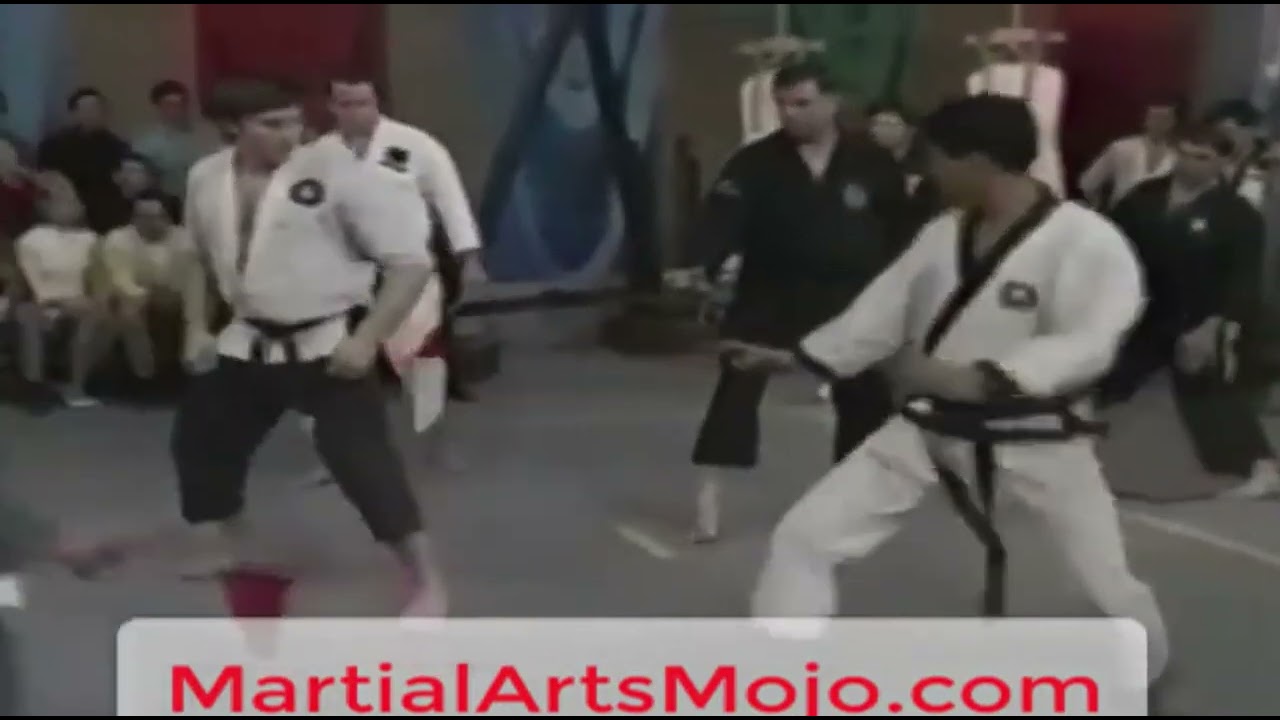
When the fighters reset, Moon switches stances, which was later revealed to be because of broken ribs suffered from the first kick. Lewis gets close and grabs Moon’s lead hand to distract him, then crushes the other side of his abdomen. Moon just couldn’t protect his torso fast enough.
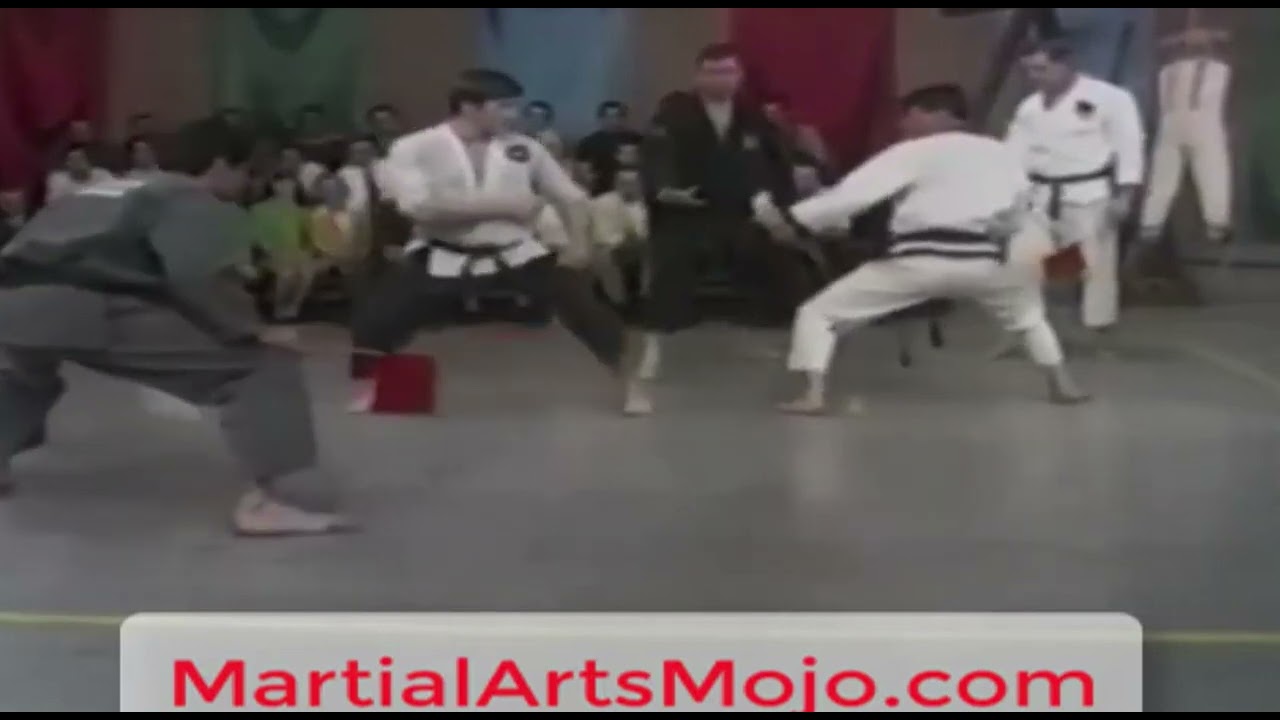
One word comes to mind when I watch Lewis throw these kicks.
DAMAGE.
Throughout the 1960s, point karate in America was pretty unique. The rule set for the events Lewis fought in were considered “light contact”, and would have been two combatants meeting on a hard floor (often a gymnasium) or large mat, wearing a full Karate uniform, and the parameters would look something like this: no strikes below the waist, full contact with punches and kicks to the body allowed up to the chest, light contact to the head (with “light” being up for interpretation). Fighters would either be bare fisted or with hand wraps, and bare feet. You’ve heard somebody use the term “pulling punches”, and point Karate is partially where that phrase comes from. Fighters would pull back on their punches to avoid making strong contact with the face, and you can see how that way of thinking can quickly lead to either heavier accidental contact, or virtually none.
During the 70s and 80s, there were limited rule sets for full contact events:
Full-Contact: Full contact above the waist, no clinching or throwing, minimum or continual kick requirement (meaning you had to throw a certain number of kicks in the fight, or it would just be boxing). This rule set was considered PKA or American Kickboxing style.
International: The same as full contact but with low kicks and sweeps added, and no minimum kick requirement. This was considered WKA or freestyle.
International rules bouts at that time were closer to what K-1 is now, which became so unique and popular throughout the 90s that its rule set became a global standard for kickboxing. In K-1, fighters are allowed to clinch.
As of August 2011, S.T.A.R. (Standardized Tournaments and Ratings System) has Joe Lewis’s official full-contact (or kickboxing) record listed as 17-4, with an 80 percent knockout rate. Exhibitions aren’t counted because knockouts aren’t allowed, but I suppose Wally Slocki would have a different opinion on that.
What Style Really Means
Joe Lewis was a fighter who could adapt to any opponent or fighting scenario. He fought in small and large rings (or just on hard floor), with or without gloves, in uniform or in trunks. He seemed more likely to fight from an orthodox stance, and at other times (like against Bill Wallace in 1970), he would fight almost entirely from the southpaw position. Like most Karate fighters, he switches stances often and looked for different offensive techniques for each. In Karate it was difficult for anyone to stop his lead leg side kick from orthodox, and in kickboxing, his (double) lead hook from southpaw. He does feint quite a bit but mostly small movements, usually in the hips. Throughout his kickboxing days he regularly used his size and strength. You can see him grab a collar tie on Wally Slocki and use it to land some good inside shots:
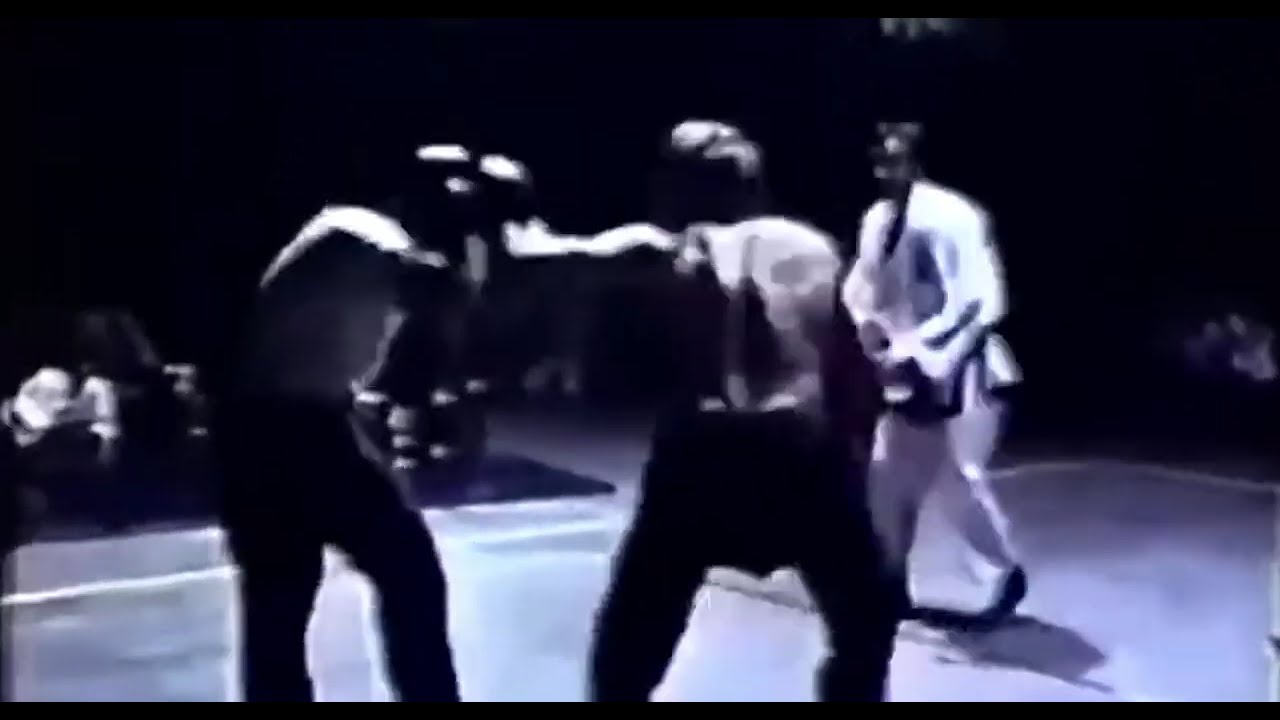
Joe Lewis finishes this fight with a beautiful knee from the clinch. This fight was supposed to be an exhibition but Lewis felt that Wally turned it into a real fight, and responded in kind. Muay Thai hadn’t made it to America yet, making Lewis the first fighter in the country to knock somebody out with a knee.
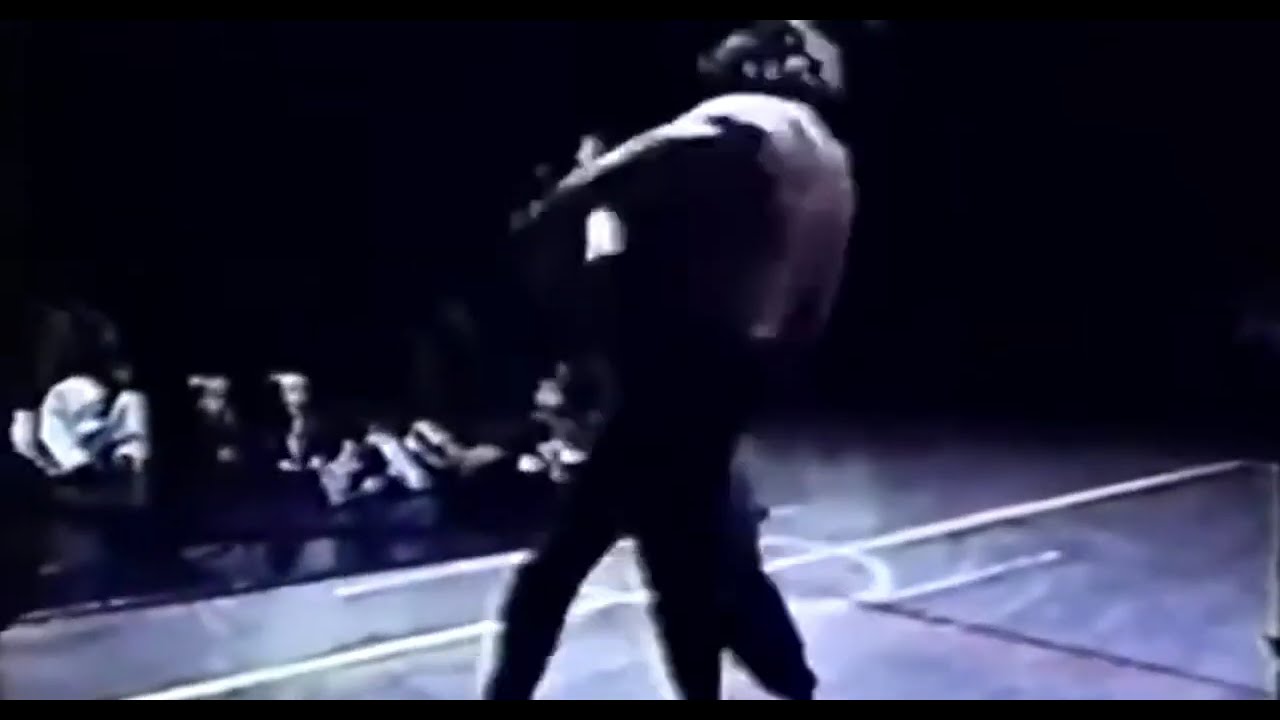
In Karate he was an aggressive fighter, and often blitzed with multiple strikes. He did the same in Kickboxing but with few rules limiting the damage he could do, Lewis could pressure fighters with impunity, knowing he was a level above most guys on the scene in those early days. He could check kicks really well and due to his dexterity, he could bring his lead leg up incredibly high. Watch him check this middle kick:
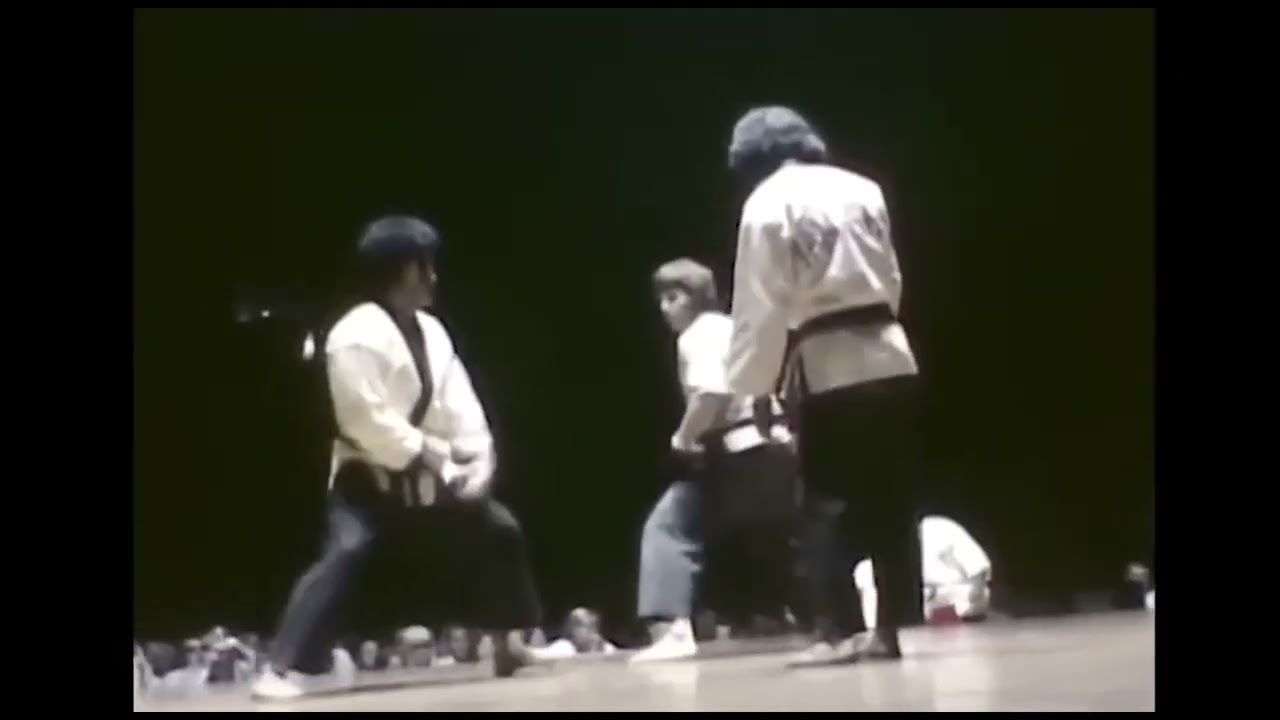
Lewis could fight on the inside, kick from distance, bully guys, or play the matador. In his mind a fighter’s style depends on circumstances such as yours and your opponent’s size, specialty, strengths and weaknesses, and when it comes to environment it depends on factors such as floor type and ring size. He understood that real fighting takes place at any given time, with a variety of different opponents, in vastly different environments. Nobody comprehends that better than a guy that fought in the first full contact match in America with only heavy bag training and roadwork.
Conclusion
Joe Lewis had an extraordinary mind for fighting. This was evident in his getting a black belt after only 7 months of training, and competing after only 22 total months of Shorin-ryu Karate to his name. With this knowledge, it’s remarkable what Joe Lewis was able to achieve, and the legacy he left behind. He understood early on that point sparring wasn’t an effective way of measuring skill and ability, and he wanted to progress fighting in America towards something more realistic and practical. Lewis went on to create his own program called the Joe Lewis Fighting System, trained many students, and conducted seminars all over the world. He is consider by many to be the greatest Karate fighter who ever lived.
1 Like