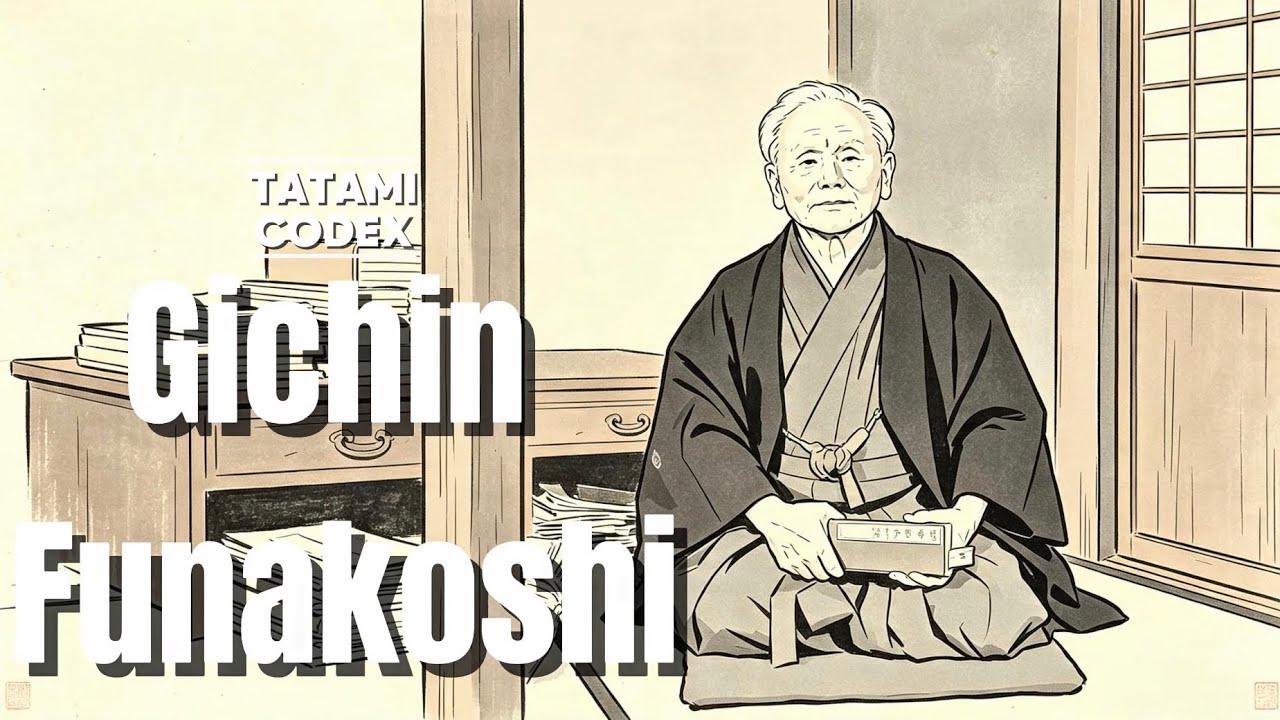
The most important figure in modern karate was not a warrior, not a general, not a monk. He was a schoolteacher in Okinawa who taught a secret village art to anyone who would listen — and then watched the art outgrow him.
Born in 1868, Gichin Funakoshi carried karate from the islands of Okinawa to mainland Japan, surviving the Meiji upheaval, the near-erasure of his native culture, and eventually a world war that burned down his dojo and his life’s work.
His 1922 demonstration in Tokyo — witnessed by the founder of judo, Jigoro Kano — changed the course of martial arts history.
But the karate the world practices today is not the karate he taught.
His own son rewrote the technique. His own students split over what the art should become: competition or contemplation. This is the full story of the father of modern karate — the man, the myth, and the quiet tragedy of a legacy he could not control.
Black people invented Karate
Ask them
Skoolteacher imo
Cliffs?


edit
Karate originated in the Ryukyu Islands (modern-day Okinawa) as a blend of indigenous fighting techniques called Te (hand) and Chinese martial arts. Because weapons were strictly banned by governing authorities, Okinawans secretly refined these devastating, bare-handed combat styles over centuries.
Born in Shuri, Okinawa, in 1868, Funakoshi trained late at night under legendary masters like Anko Asato and Anko Itosu to bypass laws prohibiting martial arts practice.
By the early 20th century, the secrecy surrounding the art began to fade. Funakoshi, who worked as a schoolteacher, assisted in integrating karate into the physical education curriculum of Okinawan public schools.
His life changed drastically in May 1922 when the Japanese Ministry of Education invited him to demonstrate the art at the First National Athletic Exhibition in Tokyo. His graceful, highly controlled demonstration captivated the mainland audience, including Jigoro Kano, the revered founder of Judo.
Due to the overwhelming interest generated by the exhibition, Funakoshi chose to stay in Tokyo permanently to teach and spread the art. To make the brutal Okinawan fighting method acceptable to mainland Japanese society, Funakoshi made profound philosophical and structural changes.
The art was originally written with Kanji that meant “Chinese Hand”. Funakoshi changed the characters to mean “Empty Hand” (Karate), reflecting a Zen Buddhist philosophy of emptying oneself of ego and evil thoughts.
He evolved the focus from Karate-jutsu (the technique of the empty hand) to Karate-do (the way of the empty hand), emphasizing that martial arts are a lifelong path of character development, humility, and self-discipline rather than just a combat sport.
Borrowing elements from Judo, he introduced the uniform (gi) and the colored belt ranking system (kyu/dan) to make the curriculum structured and accessible to university students.
In 1936, his students built a dedicated training hall in Tokyo and named it Shotokan (“The House of Shoto”). “Shoto” was Funakoshi’s poetic pen name, meaning “waving pines”.
Today, Shotokan Karate stands as the most widely practiced style of karate in the world. Funakoshi’s core principles, summarized in his famous Twenty Precepts of Karate, still guide millions of practitioners globally.